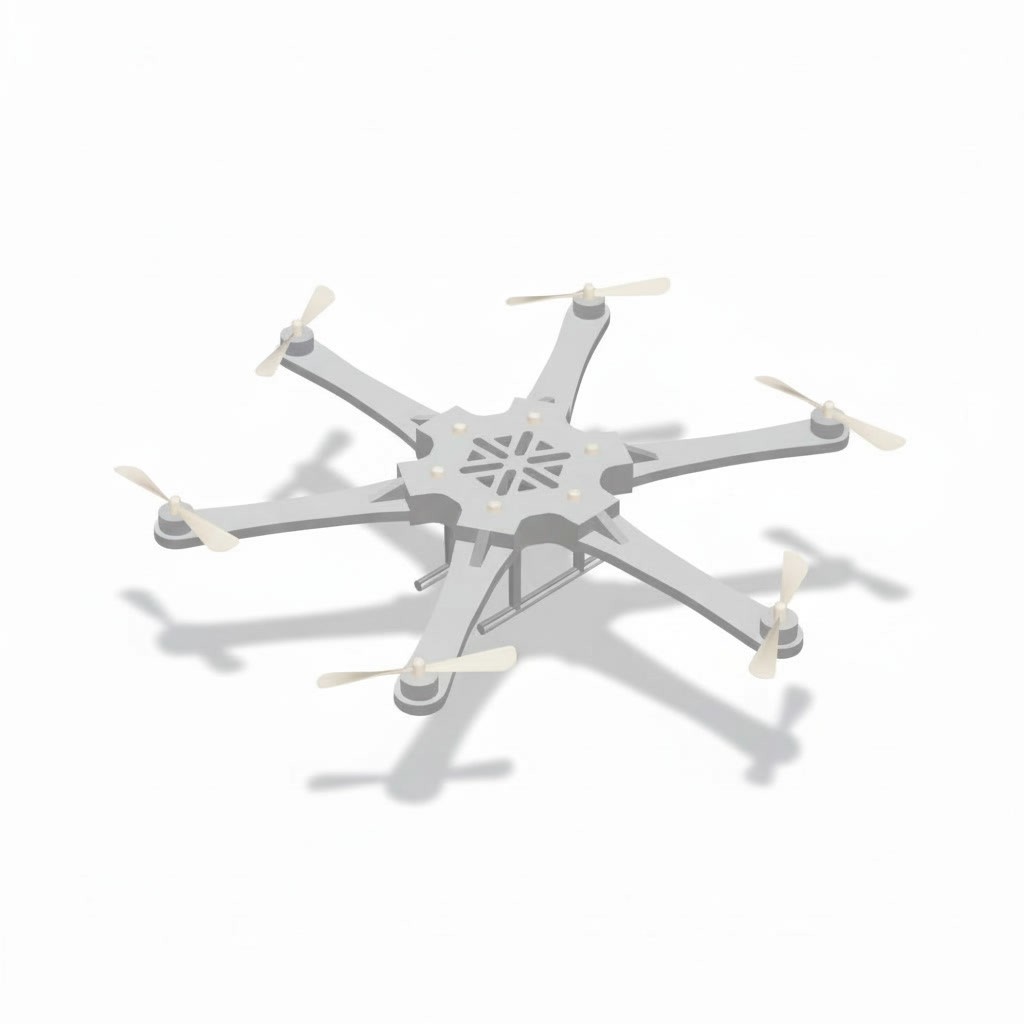
Drone Render
A basic GD&T Drone Model
For a mechanical design course, I designed a fully dimensioned, manufacturable drone assembly in Autodesk Fusion 360, applying GD&T principles to communicate tolerances and fit requirements. Starting from market research into existing drone form factors, I iteratively refined the geometry across multiple design cycles, evaluating each version against manufacturability criteria. The final deliverable was a complete engineering drawing package with GD&T annotations on critical features—demonstrating the ability to translate conceptual design into documentation suitable for real-world fabrication.

Overview
This project was the culmination of a mechanical design course focused on engineering drawing standards, CAD proficiency, and the iterative design process. My goal was to produce a fully dimensioned, manufacturable drone model that demonstrated competency in both geometric dimensioning and tolerancing (GD&T) and real-world design thinking. The project required balancing technical accuracy with practical constraints, resulting in a deliverable that reflected industry-standard documentation practices.
Project Objective
My objective was to design a drone assembly in CAD from initial concept through final dimensioned draft, applying GD&T principles to communicate tolerances and fit requirements clearly. Beyond geometry, the design had to reflect an awareness of manufacturability and cost considerations, meaning the model could plausibly transition from drawing to production without requiring unrealistic materials, processes, or assembly conditions.
What Was Done
I began with market research into existing consumer and hobbyist drone designs, identifying common form factors, frame geometries, and component arrangements to inform a viable starting point.
Using Autodesk Fusion 360, I developed a drone model iteratively, refining geometry across multiple design cycles to improve structural logic, part relationships, and dimensional clarity.
I evaluated each iteration against manufacturability criteria, ensuring features were appropriately constrained and that tolerances were applied meaningfully rather than arbitrarily.
I produced final technical drawings within Fusion 360's drafting environment, applying GD&T annotations to critical features in accordance with standard engineering drawing conventions.
End Result
My final deliverable was a fully drafted drone model with complete GD&T annotations, ready for review as an engineering drawing package. The design reflected a coherent iteration history from initial reference research through successive CAD refinements, and demonstrated the ability to produce documentation that communicates design intent to both manufacturing and engineering stakeholders. The project served as a practical exercise in translating conceptual design into a format suitable for real-world fabrication planning.