
The F.A.T. App
How a PRD + AI replaced years of scrap paper
As an Applications Engineer at Sealed Air, I identified a recurring gap in how machine commissioning data was captured during Factory Acceptance Testing: critical configuration details were living on scrap paper and in personal notes, causing institutional knowledge to get lost between projects and field issues. I treated it as a product problem: writing a PRD, then independently designing and building a WinForms tool that gave engineers a standardized, single source of truth for capturing and retrieving machine setup data, complete with embedded reference visuals and rules-based troubleshooting guidance, despite having no prior experience building a full application on my own.


Overview
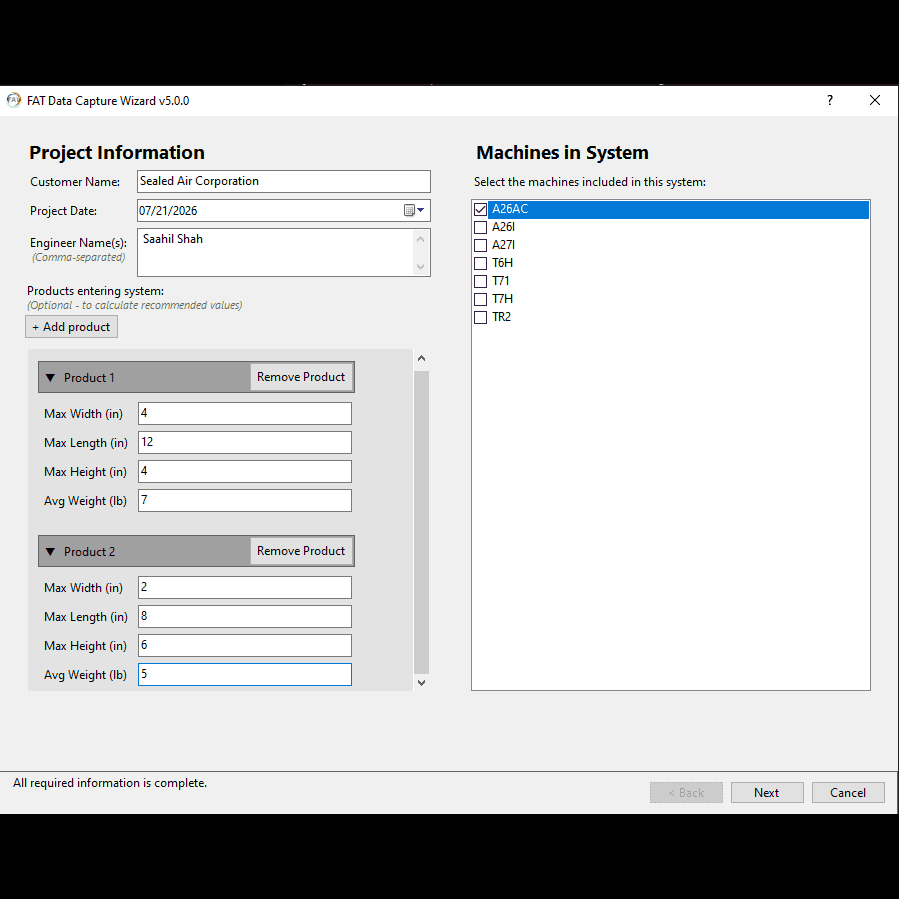
As an Applications Engineer at Sealed Air, a core responsibility involves conducting Factory Acceptance Tests (FATs) on large industrial packaging machines before they ship to customers. These machines have dozens of configuration points spanning software-defined recipe parameters, mechanical adjustments, and product-dependent settings, all of which need to be captured accurately and retained for the lifetime of the machine. Recognizing a persistent gap in how this data was managed, I took the initiative to design and build a standardized internal tool that replaced an ad-hoc, paper-based process with a structured digital workflow.
The Challenge
For years, FAT configuration data lived on scrap paper or in individual engineers' personal notes, creating a recurring organizational problem:
Institutional knowledge was frequently lost when a machine had a field issue months or years after commissioning
Project handoffs between engineers often meant configuration history was incomplete or inaccessible
No standardized format existed for capturing mechanical and software properties across the 10+ machine types in Sealed Air's product lineup
Engineers lacked in-context guidance during setup, increasing reliance on tribal knowledge and the risk of entry errors
Because the tool needed to be adopted and maintained by engineers rather than a dedicated software team, any solution also had to be simple, extensible, and easy to debug - not just functional.
My Role
I owned this project end-to-end, from problem definition through deployment:
Authored a Product Requirements Document (PRD) defining the tool's scope, including customer project data (name, date, product types, line configuration) and structured, human-readable output
Selected the technical approach: a WinForms (C#) backend with .NET-based UI framework, JSON machine configuration files, and formatted excel sheet outputs prioritizing fast iteration and low operational overhead
Used Microsoft Copilot and Sealed Air's own GPT wrapper (enterprise-provided) as a development aid to scaffold the application, despite not having previously built a full web application independently
Designed the data model to support 10+ standardized machine types, letting engineers define a customer project and build a multi-machine line from modular components
Iteratively tested the tool across real customer commissioning scenarios before rolling it out for broader internal use
Building the Tool
The application walks engineers through data collection field-by-field for each machine in a line, with embedded reference diagrams and HMI screen visuals tied to the specific property being recorded to reduce lookup time and entry errors. It also incorporates a rules-based troubleshooting layer: when entered values fall outside historically validated ranges, the tool flags the discrepancy and surfaces relevant guidance, turning routine data entry into a source of institutional knowledge capture.
Key elements the tool centralized include:
Machine-specific mechanical and software setpoints
Customer project records tied to a defined line configuration
Reference diagrams and HMI visuals linked to specific data fields
Historical setpoint ranges used to flag out-of-range entries
Results & Impact
The tool delivered a reliable, standardized workflow for FAT data collection that replaced fragmented paper and notes-based processes across the team. Key outcomes included:
A single source of truth for machine commissioning data that persists beyond any one engineer's involvement
Organized, exportable tables replacing scattered notes and scrap paper
Reduced entry errors and lookup time through embedded reference visuals
Built-in troubleshooting guidance driven by historical setpoint data
An extensible, JSON-backed architecture that made it straightforward to add new machine types as the product lineup grew
The project reinforced my ability to identify a systems-level operational gap, translate it into a formal product requirement, and independently deliver a working tool, while working within the constraints of a team without dedicated software development resources.

← Previous Post
